
Close
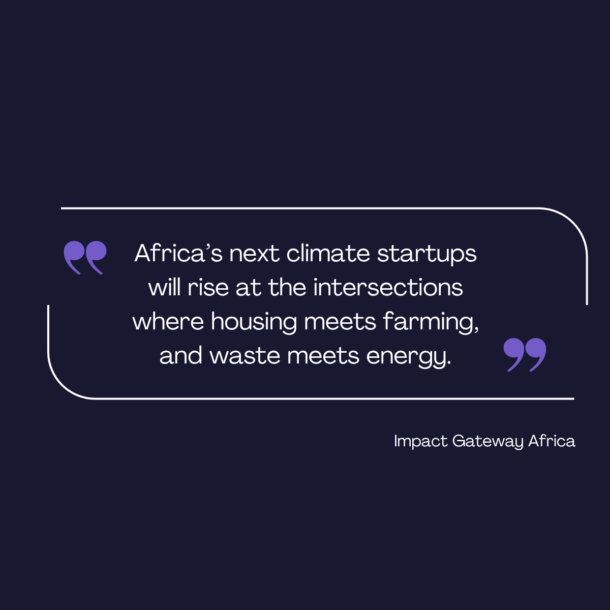
In our previous post, we explored how Africa’s innovators are blurring the boundaries between housing, energy, agriculture, and waste management: designing systems that work together, not apart. In this next post, we turn to value: the urgent question of how Africa ensures that the climate-positive work of its founders, builders, and communities is recognized, measured, and rewarded in the global carbon and climate finance economy.
Africa has been creating climate value long before global markets learned how to price it from communities using earth to build their homes, to start-ups turning bamboo into green housing frames, to entrepreneurs capturing biogas from organic waste, to farmers regenerating degraded soils. Across the continent, impact has always come before investment.
But here’s the paradox: while African communities and innovators are cutting emissions, restoring ecosystems, and improving resilience, most of that value remains invisible to financial systems. The carbon Africa saves, stores, and prevents from being emitted often goes unmeasured, uncredited, and unrewarded. At Impact Gateway Africa, we believe the question is no longer whether Africa creates climate value, but when the world will learn to value it fairly.
The global carbon economy was not designed with Africa in mind. Its systems, from verification to valuation, often assume scale, data infrastructure, and transaction costs that make sense in industrial economies but not in village cooperatives, peri-urban or community-based start-ups. Yet Africa’s models hold something different: climate solutions embedded in community life. Projects here don’t just sequester carbon; they strengthen food security, improve health, and create livelihoods. They don’t separate mitigation from adaptation; they merge them, because community needs and opportunities for solutions do not exist in silos.
The problem is that traditional carbon markets don’t yet know how to account for this kind of multidimensional value. That’s why Africa’s voice is essential, not just to participate in carbon markets, but to reshape them. Through partnerships that combine community-generated data, open-source monitoring tools, and local verification networks, the continent can lead in designing a more credible, equitable, and contextual carbon economy.
Africa’s climate founders are innovating faster than finance can follow. They sit at the intersection of mitigation, adaptation, and inclusion, and that makes them hard to categorize, and, therefore hard to fund. A start-ups that builds solar-powered brick kilns from agricultural waste doesn’t fit neatly into “energy,” “agriculture,” or “housing.” It fits into the future. But traditional financing models prefer boxes, not bridges.
The result is the carbon readiness gap: the mismatch between Africa’s real world innovation and the financial world’s recognition of that innovation. Supposedly, because promising ventures that already generate measurable climate benefits lack the tools, data, or language to translate those benefits into bankable metrics.
At Impact Gateway Africa, we see this as an opportunity, not a barrier. Our approach focuses on building carbon intelligence for African start-ups: helping them understand, quantify, and communicate the climate value they already create. This means demystifying the technical side of climate finance, turning MRV (Measurement, Reporting, and Verification) into a practical toolkit rather than a bureaucratic maze. It means connecting founders with data partners who can translate local impact into verifiable global metrics without erasing context or community. Because for too long, carbon accounting has been a distant, donor-driven exercise. We believe it can become a founder-driven advantage; a way to attract investment, prove impact, and tell the full story of Africa’s innovation.
We believe that since Africa’s innovators are already generating climate value, then the goal is not charity, it is equity. The next evolution of climate finance must flow from extraction to partnership, from valuation gaps to value capture. That means:
• Building carbon markets that reward inclusion, not just emission math.
• Designing verification systems that credit co-benefits like health, jobs, and resilience.
• Ensuring that local communities and founders retain ownership of their data and the credits it generates.
When climate finance works for Africa, it won’t just channel dollars. It will circulate dignity. This means:
• Founders investing time in understanding their climate footprint, not just as compliance, but as storytelling. The ability to measure impact is the new currency of trust and investment.
• Inventors looking beyond offsets; appreciating that the most meaningful carbon investments will come from ventures that integrate carbon reduction with community development and circular innovation, and
• Policy makers are creating enabling frameworks for locally rooted carbon registries, open MRV platforms, and Africa-wide collaboration on data standards. Africa’s climate wealth must be documented by Africa, not just observed about Africa.
Africa’s innovators have already been rewriting the rules of climate impact. The next step is ensuring that the rules of climate finance catch up, so that the value created in African fields, labs, and workshops is reflected in global ledgers. Because Africa doesn’t just absorb the world’s emissions, it designs the world’s solutions.